
Blog
Sharing a Table – FineWoodworking

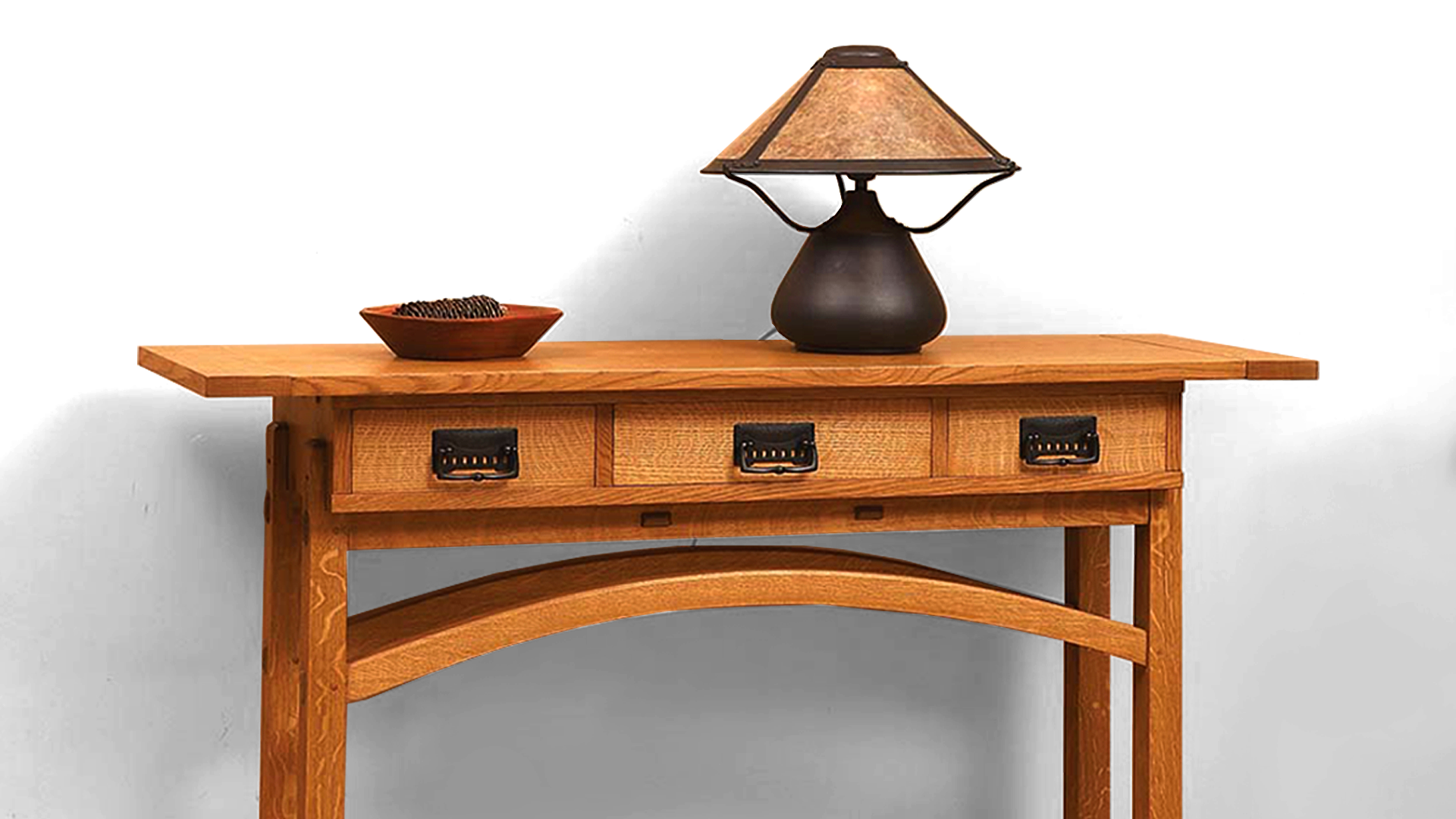
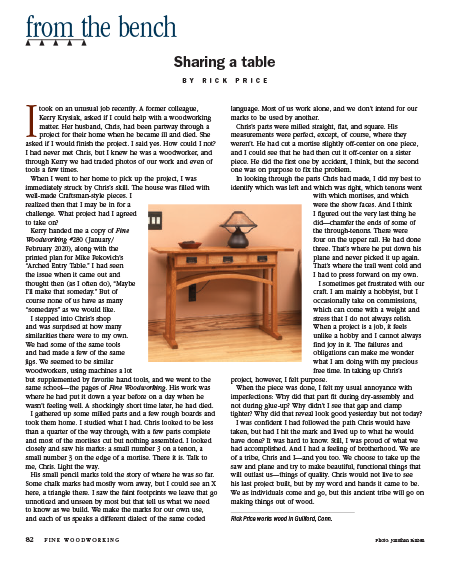
I took on an unusual job recently. A former colleague, Kerry Krysiak, asked if I could help with a woodworking matter. Her husband, Chris, had been partway through a project for their home when he became ill and died. She asked if I would finish the project. I said yes. How could I not? I had never met Chris, but I knew he was a woodworker, and through Kerry we had traded photos of our work and even of tools a few times.
When I went to her home to pick up the project, I was immediately struck by Chris’s skill. The house was filled with well-made Craftsman-style pieces. I realized then that I may be in for a challenge. What project had I agreed to take on?
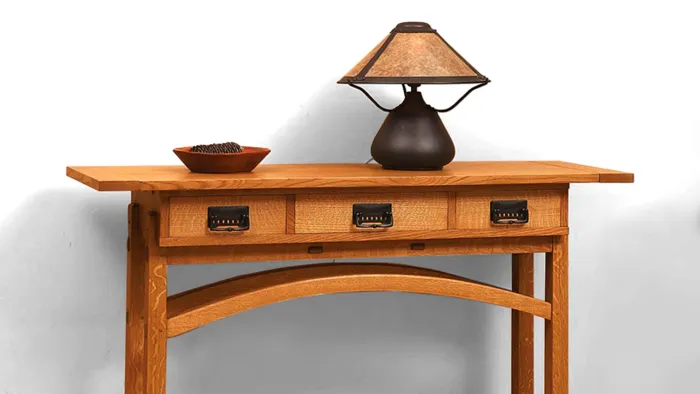
Kerry handed me a copy of Fine Woodworking #280 (January/February 2020), along with the printed plan for Mike Pekovich’s “Arched Entry Table.” I had seen the issue when it came out and thought then (as I often do), “Maybe I’ll make that someday.” But of course none of us have as many “somedays” as we would like.
I stepped into Chris’s shop and was surprised at how many similarities there were to my own. We had some of the same tools and had made a few of the same jigs. We seemed to be similar woodworkers, using machines a lot but supplemented by favorite hand tools, and we went to the same school—the pages of Fine Woodworking. His work was where he had put it down a year before on a day when he wasn’t feeling well. A shockingly short time later, he had died.
I gathered up some milled parts and a few rough boards and took them home. I studied what I had. Chris looked to be less than a quarter of the way through, with a few parts complete and most of the mortises cut but nothing assembled. I looked closely and saw his marks: a small number 3 on a tenon, a small number 3 on the edge of a mortise. There it is. Talk to me, Chris. Light the way.
His small pencil marks told the story of where he was so far. Some chalk marks had mostly worn away, but I could see an X here, a triangle there. I saw the faint footprints we leave that go unnoticed and unseen by most but that tell us what we need to know as we build. We make the marks for our own use, and each of us speaks a different dialect of the same coded language. Most of us work alone, and we don’t intend for our marks to be used by another.
Chris’s parts were milled straight, flat, and square. His measurements were perfect, except, of course, where they weren’t. He had cut a mortise slightly off-center on one piece, and I could see that he had then cut it off-center on a sister piece. He did the first one by accident, I think, but the second one was on purpose to fix the problem.
In looking through the parts Chris had made, I did my best to identify which was left and which was right, which tenons went with which mortises, and which were the show faces. And I think I figured out the very last thing he did—chamfer the ends of some of the through-tenons. There were four on the upper rail. He had done three. That’s where he put down his plane and never picked it up again. That’s where the trail went cold and I had to press forward on my own.
I sometimes get frustrated with our craft. I am mainly a hobbyist, but I occasionally take on commissions, which can come with a weight and stress that I do not always relish. When a project is a job, it feels unlike a hobby and I cannot always find joy in it. The failures and obligations can make me wonder what I am doing with my precious free time. In taking up Chris’s project, however, I felt purpose.
When the piece was done, I felt my usual annoyance with imperfections: Why did that part fit during dry-assembly and not during glue-up? Why didn’t I see that gap and clamp tighter? Why did that reveal look good yesterday but not today?
I was confident I had followed the path Chris would have taken, but had I hit the mark and lived up to what he would have done? It was hard to know. Still, I was proud of what we had accomplished.
And I had a feeling of brotherhood. We are of a tribe, Chris and I—and you too. We choose to take up the saw and plane and try to make beautiful, functional things that will outlast us—things of quality. Chris would not live to see his last project built, but by my word and hands it came to be. We as individuals come and go, but this ancient tribe will go on making things out of wood. 
Rick Price works wood in Guilford, Connecticut.
|
From Fine Woodworking #325 To view the entire article, please click the View PDF button below. |
 |
Sign up for eletters today and get the latest techniques and how-to from Fine Woodworking, plus special offers.
Download FREE PDF
when you enter your email address below.
View PDF