Blog
Wood Moves, but How Much?

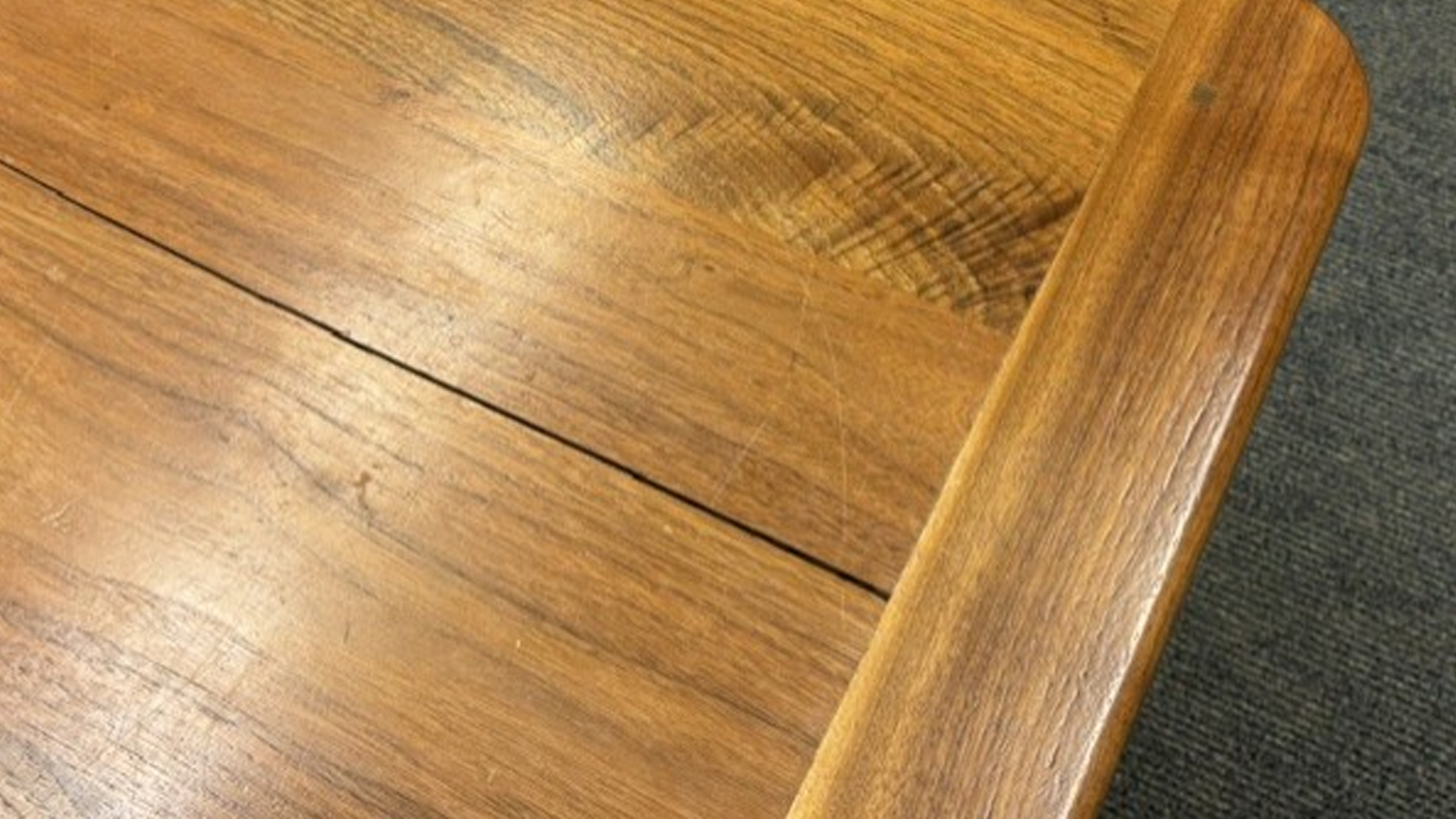
Designing for wood movement is essential in furniture making. If it is ignored, pieces can fail. My first project was a stereo cabinet I built in college using beautiful white oak boards. During summer break, I sawed, sanded, and glued the cabinet together. Then in January, when temperature and humidity were at their lowest, the back split from top to bottom. It took me a few years to understand why.
Wood moves, but how much? And how do we design around it? Wood is an anisotropic material, which means it has different properties in the different directions of the wood. Its movement in its length is not enough for furniture makers to take into consideration. Whereas its movement in the tangential and radial directions is substantial over the course of a year.
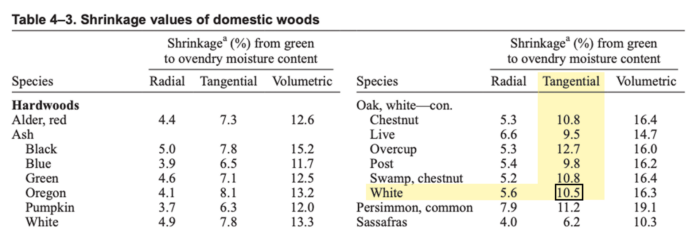
Using data gathered and published in chapter four of Wood Handbook by the Forest Products Laboratory, a research unit of the USDA Forest Service, is a good starting point to calculate the tangential and radial changes in boards. If you were making a 36-inch wide dining table top out of flatsawn white oak boards, you would use the tangential shrinkage from Table 4-3 (p. 102) of 10.5-percent. This means that a flatsawn white oak board going from a green state of 30-percent moisture content to an oven-dry state of 0-percent moisture content would shrink 10.5-percent in width.
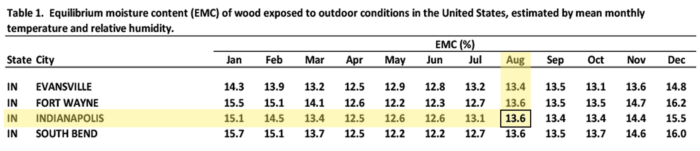
To calculate the amount of yearly shrinkage in your region, you need to find out the maximum equilibrium moisture content (EMC) in your house with the windows open and no air conditioning or heating. This can be found through The Equilibrium Moisture Content of Wood in Exterior Locations in the United States chart created by North Carolina State University. Look for a city near you and find the average EMCs for each month. I chose Indianapolis in August, which yields an EMC of 13.6-percent.
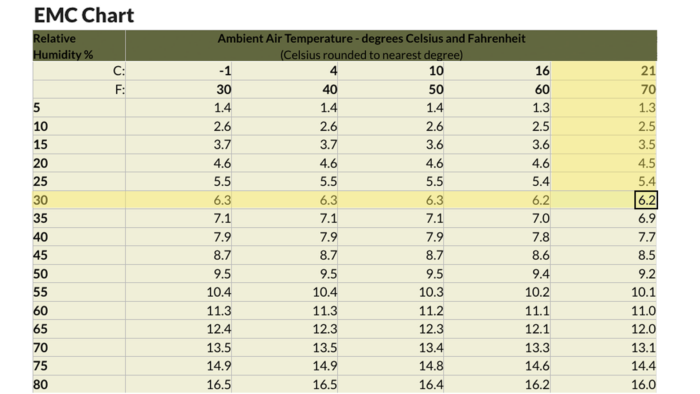
To determine the lowest moisture content my table will experience, I use the expected temperature and relative humidity that my house will be in the winter. I like to have my thermostat set at 70°F and the relative humidity around 30-percent. If the relative humidity gets much lower my skin gets very dry, and if it gets much higher moisture will condensate on my windows. I can use a chart and calculator from the Woodworkers Source website to determine that the EMC of the furniture in my home will be 6.2-percent in the winter months.
The calculation for the change in width is as follows:
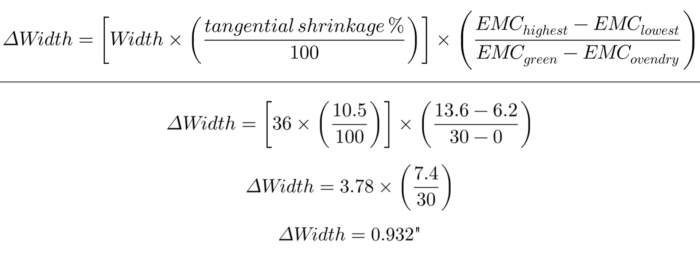
For all woods, the EMC at green state is 30-percent and the EMC at oven-dry state is 0-percent. I can plug my data into the formula to get a change in width of 0.9324-in. This is almost one inch. If I don’t design my table to allow for that much change, I will inadvertently get a river table.
See the links below to locate the data needed to calculate wood movement:
Sustainably Sourced Wood
Breadboard Ends: 4 Ways
Sign up for eletters today and get the latest techniques and how-to from Fine Woodworking, plus special offers.